The Refill Habit That Starts with a Container Check
A refill habit works better when the container suits its contents, journey and storage place, helping you avoid awkward transfers and unused packaging.
The common mistake with a refill habit is buying a handsome jar or bottle before checking what it needs to hold. The result can be a container that does not fit the refill opening, cannot travel without leaking, or has nowhere sensible to live at home. Start with the contents and the routine, then choose the vessel.
A refill container has to fit a whole routine
Refill shopping moves a product through several stages: it is dispensed, carried, brought home, stored and used. A container that works at one stage can be awkward at another. A wide-mouth tub may be easy to fill but bulky in a bag; a slim bottle may travel neatly but be difficult to clean or refill.
“Container” can mean a bottle, jar, tin, lidded tub or a vessel supplied by a shop. The right choice depends on the product’s form and the shop’s dispensing system, as well as your own storage and handling habits. A refill routine is practical only if the container can complete the whole journey without creating extra decanting or waste.
Before choosing, name the product and the place it will be used. Dry lentils for a kitchen cupboard call for different features from hand soap kept beside a shared bathroom sink. That distinction is more useful than starting with a preferred material or style.
Match the container to what it needs to hold
Consider whether the contents are dry, liquid, granular, oily or prone to clumping. Dry goods such as rice or oats are easier to pour from a wide opening, while a liquid needs a secure closure and a shape that is comfortable to handle. Fine powders may escape through gaps that would not trouble larger grains.
Look at the dispensing method, too. Some refill shops use gravity dispensers that suit a wide opening; others use taps or pumps that may need a narrower neck. A funnel can help with a small opening, but it is another item to carry, clean and store. Ask the shop how its dispensers work if the fit is unclear.
Material affects everyday use. Glass is easy to see through and does not retain odours as readily as some porous materials, but it can be heavy and breakable. Lightweight plastic may be easier to carry, while metal can block the view of what remains. These are trade-offs, not a ranking: choose for the contents, handling and place where the vessel will sit.
For products that may react with a material, or where safe storage is uncertain, follow the product label and the container manufacturer’s instructions. Local shop rules can also determine which vessels are accepted.
Check how the container will travel and be stored
A container used outside the home needs to survive the trip as well as the refill. Think about the route from the shop: will it be carried in a tote with groceries, placed upright in a bicycle basket, or taken home on foot? A lid that is merely resting in place may be fine on a shelf and unreliable in a moving bag.
At home, check the actual storage spot rather than an imagined one. A tall bottle may not fit beneath a cupboard shelf; a broad jar can crowd a narrow pantry ledge. If the container must be reached often, leave room to lift it out without shifting other things.
Capacity is part of this check, but “larger” is not automatically more convenient. A vessel that holds more than you can use comfortably may become an awkward fixture, while one that is too small may require repeated trips or an extra transfer. Base the choice on how much you use and where the supply can be kept.
Say you want to refill oats at a neighbourhood shop. Imagine your cupboard has a low shelf and your shopping tote is already used for other groceries. A short, wide jar with a well-fitting lid may be easier to fill and store than a tall decorative canister; checking the dispenser opening first would show whether the jar can be filled directly or needs a funnel.
Make cleaning and reuse part of the choice
Refill containers need to be clean and ready when you take them back. A narrow neck, fixed pump or complicated lid can make washing and drying difficult. Residue or moisture left inside may affect the next refill, particularly with foods or products that need to remain dry.
Choose a shape you can inspect and clean using tools you already have, such as a washing-up brush or bottle brush. Check whether the lid comes apart without force and whether the container can dry fully before it is stored. If cleaning it becomes a special chore, the refill routine may be harder to maintain.
It can also help to keep the container dedicated to one kind of product. A label written on masking tape, or a removable tag, can make the contents clear without leaving permanent marks. This is especially useful when vessels look alike or several people share the cupboard.
Do not treat every empty package as suitable for every refill. Packaging designed for a particular product may not be appropriate for another use, and a shop may have its own hygiene requirements. Check the relevant instructions rather than relying on appearance alone.
Build a small, workable set rather than collecting jars
One dependable vessel for a product you refill regularly is often more useful than a cupboard of containers saved “just in case”. Start with the item that already fits your routine, then add another only when you know its contents, filling method and storage place.
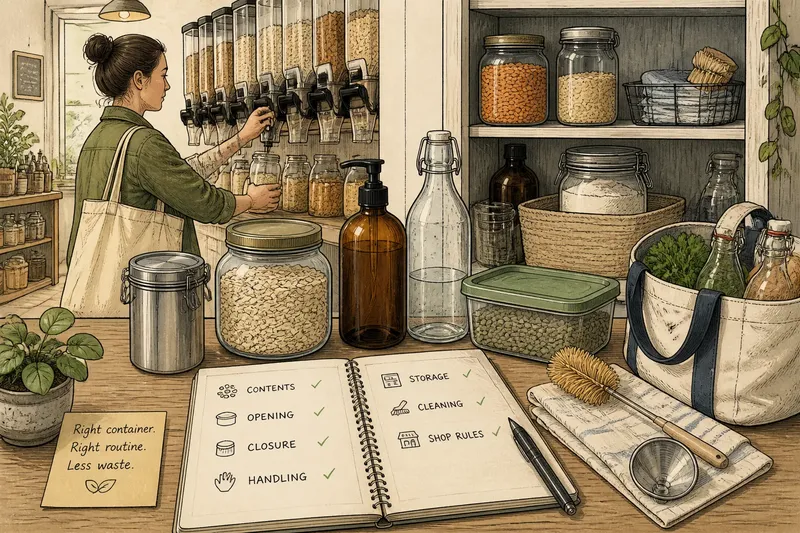
Before taking a container to a refill shop, check:
- Contents: Is the product dry or liquid, and does it need protection from air, moisture or light?
- Opening: Can the shop’s dispenser fill it without spills, or will you need a funnel?
- Closure: Does the lid or cap stay secure during the journey home?
- Handling: Is it comfortable to carry when filled, and easy to grip while pouring?
- Storage: Does it fit the cupboard, shelf or counter space where the product will be used?
- Cleaning: Can you wash, inspect and dry it thoroughly with ordinary household tools?
- Shop requirements: Does the retailer accept this kind of vessel and require it to be clean, weighed or labelled?
Use the answers to decide whether to keep the container, adapt the routine with a simple tool, or choose another vessel. If it fails several checks, do not force it into the system because it looks reusable.
What should you check before taking a container to a refill shop?
Does the shop accept customer-owned containers?
Ask the retailer about its current process, since some shops provide their own vessels or restrict what they can refill. Find out whether a container must be clean, dry, weighed or labelled before filling.
How can you avoid spills during filling?
Match the opening to the dispenser and leave room for contents to settle rather than filling to the brim. If a funnel is needed, make sure it is suitable for that product and easy to clean afterwards.
Should one container be used for different products?
Keeping a vessel for one product makes residue and labelling easier to manage. Reuse it for something else only when the previous contents can be removed fully and the new product’s instructions allow that container material.
What if the container is awkward at home?
Try a different shelf or a simpler way of identifying the contents before replacing it. If its shape still makes access, storage or cleaning troublesome, choose a vessel designed around the actual place and task.
Let convenience decide whether the habit lasts
A useful refill container is not necessarily the prettiest or the one with the most capacity. It is the vessel that suits the product, works with the shop’s dispenser, travels securely and fits where you use it. Those details determine whether refilling feels like an ordinary household task or an extra job.
Keep the decision close to the point of use: check the container before buying it, and check the shop’s requirements before carrying it there. A refill habit built around a suitable container is easier to repeat because it asks less of your space, your hands and your routine.
For a low-waste habit, the container check is the useful starting point: choose for the contents and the journey, then let appearance come afterwards.