One Errand, Several Stops: Build a Route Around What Is Nearby
Plan one errand route around nearby stops and opening times to avoid unnecessary backtracking and make ordinary city trips easier to combine.
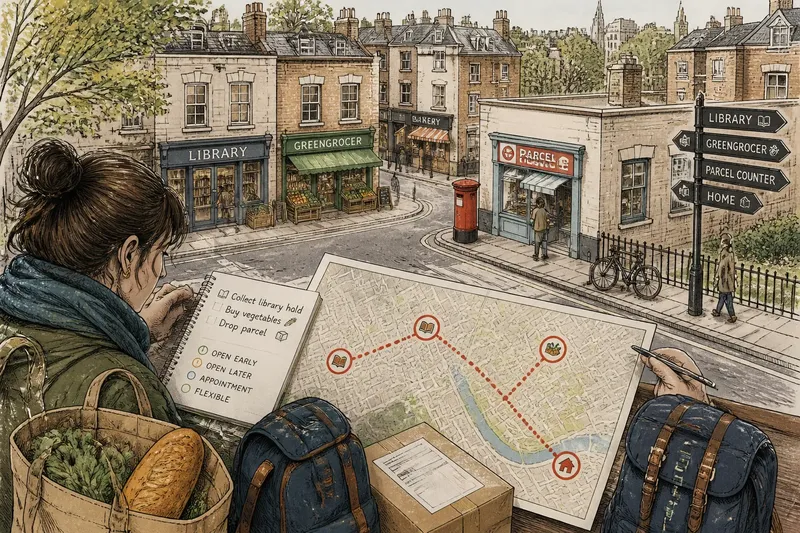
The common mistake in planning several city errands is to arrange them as a list rather than as a route. A one-errand, several-stops route works better when you group places by location and opening sequence; otherwise, you can cross the same junction twice or arrive before a service is ready to help.
Start with stops, not the order you remembered them
A mental list often puts the most important task first, followed by whatever else comes to mind. That order says little about where the places are. Write down each destination and its purpose before deciding which to visit first.
Keep the list specific: “collect a parcel at the post office” is more useful than “post office”, and “buy bread at the bakery” tells you what you need to bring or carry away. Include errands that are genuinely due, not every possible task in the neighbourhood. A longer route can cost more attention than it saves.
Mark each stop on a paper map or in a mapping app. Look for clusters on the same street, around the same square, or beside one another within a shopping parade. Nearby means more than a short line on a map: a railway cutting, a busy road crossing or a steep hill may make two close-looking addresses awkward to combine.
Keep the map view wide enough to see connecting streets, then check the walking route between stops.
Fix the route when opening times conflict
A route can look tidy and still fail because one place is not open when you reach it. This commonly happens with small businesses, collection counters, libraries and services that keep different hours on particular days. The cause is not poor map reading; it is treating every stop as if it were available all day.
Give each stop a simple timing note: open early, open later, appointment required, or flexible. Check the current opening information for anything with limited hours, and place the least flexible stop first in the sequence. Add a little breathing room rather than scheduling each arrival tightly. A queue or an unexpectedly slow service can otherwise disrupt every later stop.
If a stop is only useful at a particular time, decide whether the surrounding errands can fill the gap. A nearby grocer or café may make waiting practical, but only if the extra stop is useful and does not add a difficult detour.
Write down the stop whose hours shape the rest of the journey.
Use the opening sequence to prevent backtracking
Once the destinations and time constraints are clear, arrange them in the direction that makes sense from your starting point. The useful sequence often begins with the place that opens earliest or has the narrowest service window, then moves through nearby flexible errands on the way back.
Think in short links rather than a single grand loop: home to the first stop, then to the next, then towards home or the next fixed commitment. A loop is not automatically efficient. If the last stop leaves you far from your destination, a compact out-and-back route may be easier.
Say you need to collect a library hold, buy vegetables and drop a parcel at a counter that opens later than the library. If the library and greengrocer sit on the same high street, you might visit the library first, shop while walking towards the counter, then drop the parcel before heading home. The observable result is a route that respects the counter’s hours without making a second journey along the same stretch.
Before leaving, read the route once from start to finish and look for a stop that sends you backwards.
Choose what to carry before adding more stops
People often add errands because the places are close, then discover that the route involves awkward or fragile items. A paper bag of groceries, a book return and a parcel may each be simple on their own; together, they can be cumbersome, especially on a crowded bus or in poor weather.
Consider the shape and order of what you will collect. Carry a tote or backpack for light, non-fragile items, and keep a parcel that needs to remain dry or upright separate. If shopping is the heaviest task, place it near the end. For chilled food, avoid a long gap between buying it and getting home.
Do not add a stop merely because it is on the map. A short errand that requires carrying bulky purchases across the rest of the route may be better saved for another day.
What should you change when the plan breaks?
What if a stop is closed?
Check whether another stop nearby is still worth doing, then continue with that smaller route. Move the closed errand to a day when its hours fit naturally rather than retracing the whole journey immediately.
What if the route feels too long?
Remove the least urgent stop and keep the ones that share a location or have a limited opening window. Splitting errands is sensible when combining them would make the journey tiring or leave you carrying too much.
Should I use a bus or walk between stops?
Compare the actual door-to-door links, including the walk to a stop and any wait, rather than assuming a bus saves effort. Use whichever option suits the distance, your load and the time available.
What if I need to return home between errands?
Separate the route where the return home solves a real problem, such as storing a bulky item or collecting something essential. Then treat the later errands as a new cluster instead of pretending the interruption does not affect the sequence.
Keep the plan flexible without making it vague
A useful route has a clear starting point, a fixed stop that sets the timing, and a few nearby errands that can be rearranged. It does not need a minute-by-minute schedule. Leave optional tasks clearly optional, so a delay does not turn a manageable trip into a race.
For a final check, ask whether each destination belongs on this journey, whether it is open in the order you plan to arrive, and whether you can carry what it produces. That quick review can help you choose a compact route that fits the day, rather than forcing every task into the same outing.
Keep the route note for next time: mark any closed door, awkward crossing or useful shortcut, and update the plan before you set out again.